
In 1872, Jules Verne published a novel that, more than 140 years after its initial release, remains widely known and appreciated for its evocative power: Around the World in Eighty Days. The story follows the adventures of Phileas Fogg, a wealthy London gentleman of habitual, sedentary, and reserved character. On October 2, 1872, Fogg leaves his residence on Saville Row and heads to the Reform Club. As usual, at half past eleven he reaches the club premises after taking exactly 575 steps.
The enigmatic protagonist becomes involved in a discussion with several club members who, prompted by recent events - particularly the theft of £55,000 - debate how easy it has become for a thief to vanish in an increasingly smaller world. Fogg ends up accepting a bet proposed by Mr. Stuart and supported by fellow members Fallentin, Sullivan, Flanagan, and Ralph. The gentlemen wager £20,000 on the impossibility of circumnavigating the globe in 80 days.
Fogg departs from London the same evening, returning victorious and having won the bet 80 days later, on December 21. To accomplish the journey, he uses a wide array of means of transportation: steamships, railways, carriages, yachts, cargo ships, sleds, and even elephants. Each stage is marked by unexpected challenges and unusual adventures, often fueled by the persistence of Fix, an inspector convinced that Fogg is a bank robber and who follows him throughout the journey in an attempt to arrest him.
In addition to the written version, the theatrical adaptation-produced by Verne and Adolphe d’Ennery-also deserves mention. The premiere was held on November 7, 1874, at the Théâtre de la Porte-Saint-Martin in Paris and achieved tremendous success, running continuously until November 10, 1878.
Taken together, the novel and its theatrical version have inspired generations of travelers and marked a rupture with previous travel dynamics. With the publication of Verne’s work and its captivating adaptation, the idea of traveling around the world became a competition between reality and fiction involving fictional characters, journalists, writers, and ordinary wanderers.
The famous French poet and filmmaker Jean Cocteau, fascinated by Fogg’s adventures, completed his own journey around the world between March 28 and June 17, 1936. He wrote: “Jules Verne’s masterpiece, with its red and gold prize-book cover, and the play derived from it, behind the red and gold curtain of the Châtelet, excited our childhood and gave us, more than the sight of a globe, a love of adventure and a desire to travel” (Cocteau, Jean. Il mio primo viaggio. DeAgostini, 1964).
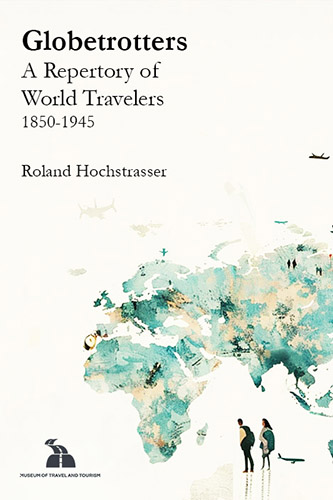
Made famous by the celebrated Phileas Fogg, the globetrotters experienced a golden age in the early decades of the 20th century, a time marked by rapid technological progress and growing curiosity about the unknown. Globetrotters from all social backgrounds embarked toward unfamiliar horizons with enthusiasm and, at times, recklessness. Imaginative and intrepid, they carried out the most unlikely expeditions, often with improvised means, contributing to the global construction of a new imagery and a new way of conceiving travel.
More info: https://museumoftravel.org/index.php/en/explore/library/3138-repertory-of-globetrotters-1850-1945